If you have ever sat in a pediatrician's office and blanked on when the fever actually started, you are in good company. Sick days blur together, especially when you are tired and worried, and even the most attentive parent can lose track of which symptom showed up on which day. A simple sick-day log fixes that.
Here is the important part: the log is not for you to interpret. You do not need to figure out what the ups and downs mean, and you should not try - that is exactly what your pediatrician's training is for. Your job is much simpler and much more doable at 2 a.m.: observe, write it down, and bring it along. The patterns in your notes are for your pediatrician to spot and make sense of.
Think of yourself as the reporter and your pediatrician as the analyst. When you show up with clear, time-stamped notes instead of "she felt warm at some point over the weekend, I think," the whole conversation gets easier, faster, and more useful for your child. That is the entire promise of a sick-day log, and it takes surprisingly little effort to keep one.
📓 What to Write Down
A useful log is just a running list of what you observed and when. You are not deciding what matters - you are capturing the raw material so your pediatrician has the full picture to work from.
- Record each temperature reading along with the time and how you took it.
- Note symptoms as you notice them, in plain words like "tugging at ear" or "raspy cough at bedtime."
- Log any medications given, including the time, exactly as your pediatrician or the pharmacist directed.
- Track sleep, naps, appetite, and drinking, since daily rhythms are part of the story.
- Add mood and behavior notes, like "clingy all morning" or "played normally after lunch."
- Write down anything that simply strikes you as different for your child, even if it seems minor.
⏰ Why Timing Is the Detail That Matters Most
Memory is famously bad at sequence. We remember that things happened but not the order or the gaps between them, and that ordering is precisely the kind of context a pediatrician wants. Time-stamping your notes is the single biggest upgrade you can make.
- Write the date and time on every entry, even quick ones.
- Log in the moment when you can, since reconstructing times later is where accuracy slips.
- Note when things started, not just that they happened, as best you can observe.
- Keep entries short so logging stays easy enough to do consistently.
- Let every caregiver add to the same log so nights, handoffs, and grandparent shifts are not blank spots.
🚫 What a Log Is Not For
A log records observations; it does not produce answers. Resisting the urge to read meaning into your notes is not a failure of diligence - it is the responsible way to use them.
- Bring your observations to your pediatrician rather than drawing conclusions from them yourself.
- Avoid comparing your notes against internet checklists to guess at what is going on.
- Skip the urge to grade readings as "good" or "bad," and simply record them as they are.
- Call your pediatrician whenever you are worried, whatever your notes say, and never wait because the log "looks okay" to you.
- Seek urgent care immediately for anything that feels like an emergency, without stopping to log first.
🗣️ How a Log Changes the Pediatrician Conversation
The difference between a vague history and a precise one is dramatic, and your pediatrician will feel it immediately. A good log turns the first ten minutes of an appointment from archaeology into a briefing.
- Answer questions like "when did that start?" with confidence instead of guesswork.
- Hand over the timeline itself so your pediatrician can review the details directly.
- Cover the gaps from other caregivers' shifts, since a shared log remembers what you were not there to see.
- Free up appointment time for your actual questions rather than reconstructing the week.
- Give the same complete picture to an urgent care or after-hours provider who has never met your child.
📋 Preparing for the Appointment
A few minutes of prep turns your log from a pile of notes into a genuinely useful handoff. The goal is completeness and clarity, so nothing gets lost between your couch and the exam room.
- Gather your questions in one list as they occur to you during the sick spell.
- Bring the whole log, not a summary from memory, so nothing is filtered out on the way.
- Mention every medication, supplement, and remedy given, even ones that seem unimportant.
- Ask your pediatrician what they would like you to observe or record going forward.
- Ask what signs should prompt a call back or urgent care, so you leave with professional guidance instead of your own guesses.
✅ Quick Action Plan
- Start a simple log today with the date, time, and whatever you observe.
- Record temperatures, symptoms, medications, sleep, appetite, and mood as they happen.
- Invite every caregiver to add their observations to the same log.
- Keep a running list of questions for your pediatrician alongside your notes.
- Bring the full log to your next call or appointment and let your pediatrician interpret it.
- Call your pediatrician with any concern, and seek urgent care for anything that feels like an emergency.
This post is for educational purposes only and is not medical advice. A sick-day log is a record-keeping tool, not a diagnostic one. Always consult your pediatrician or a qualified healthcare professional to interpret your child's symptoms and for any questions about health, medications, or treatment.
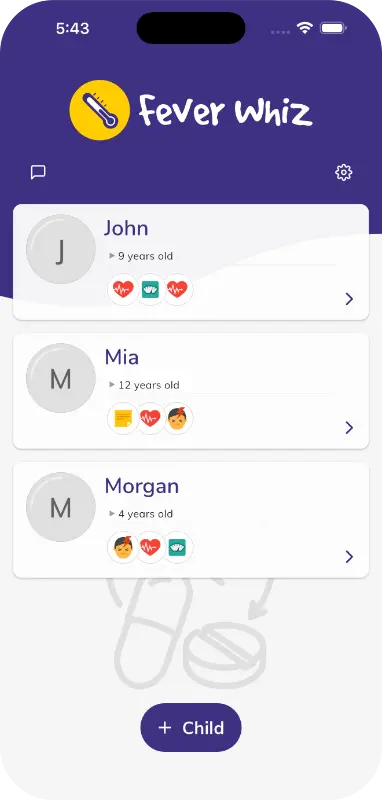
If a paper log sounds like one more thing to lose, Fever Whiz was built for exactly this. The free app lets you log temperatures, medications, and symptoms in seconds, keeps everything time-stamped automatically, and syncs a real-time care timeline with every caregiver so nothing falls through the cracks. When the appointment comes, your complete record is right there in your pocket, ready to share with your pediatrician.